
Colonization, Climate and Land Dispossession
Colonization lies at the root of today’s climate crisis.
HNLF is focused within the region we describe broadly as the eastern Tallgrass Prairie—stretching from Lake Michigan to the Platte River in Nebraska, from the Great Plains of Iowa to the Oak Savannas of Minnesota and Wisconsin, from the watersheds of the Upper Mississippi to the Missouri River. Indigenous communities have been stewarding this land since time immemorial.
European settlers used violence and other unjust means to forcibly remove Native Nations and make way for white settlement. In the U.S. today, almost 80% of Indigenous peoples live in urban areas, separated from their ancestral land. Such colonization has led to ecological disruption and the destruction of healthy soil—and lies at the root of today’s climate crisis.
Below we articulate a few of the histories and ongoing colonization processes in this area that have led to stolen land, fractured communities, and profoundly damaged lands and waters.
“This history is not your fault, but it is absolutely your responsibility.”
Doctrine of Discovery
At the root of the unjust and brutal colonization of these lands is the “Doctrine of Discovery”—a 15th-century legal and religious framework originating from papal decrees that gave Christian European nations the authority to “subdue,” “conquer,” and “vanquish,” declaring that non-Christian peoples had no inherent right to their own land.
In 1823, the Supreme Court case Johnson v. McIntosh enshrined the Doctrine of Discovery into U.S. law. The Court ruled that the “right of discovery” by “Christian people” took precedence over the rights of Native Nations, paving the way for subsequent land seizure policies. This court case remains the foundation of property law in the U.S. today, and was used as recently as 2005 to deny the Oneida nation sovereignty over their ancestral homeland.
Forced Removal
Through fraudulent treaties and violence, Indigenous communities throughout this region were repeatedly forcibly removed from their land. The Indian Removal Act of 1830 was just one devastating federal policy making way for colonization and the invasion of white communities. Many Native communities were unjustly displaced from this region, including the Ioway / Báxoje, Ho-Chunk, Omaha, Sauk, Meskwaki, Otoe-Missouria, and Oceti Sakowin.
“The lands I claim are mine and the nations here know it is not only claimed by us but by our brothers the Sacs & Foxes, Menominees, Iowas, [O]mahas and Sioux. They have used it in common. It would be difficult to divide it. It belongs as much to one as the other. ”
Homestead Act
The 1862 Homestead Act transferred 270 million acres of previously Native-stewarded land to mostly white settlers, who received 160 acres from the government for almost no cost. 45% of Nebraska's total land was distributed to settlers under the Homestead Act. Today, about a quarter of the US adult population descends from original Homestead Act recipients. The Act provided a foundation of white wealth and land-holding that persists today.
Relocation
In 1956, the federal government passed the “Indian Relocation Act,” a federal policy aimed at removing Indigenous peoples from their home communities and assimilating them into urban life in cities like Chicago, Minneapolis, and Lincoln, NE. While promised housing and employment, many Native people faced unemployment, low-end jobs, discrimination, homesickness, and the loss of traditional cultural support. Today, almost 80% of Native people live not on reservations, but in cities around the country.
Climate Crisis & Ecocide
Attacks on people have always been connected to attacks on the rest of the living world.
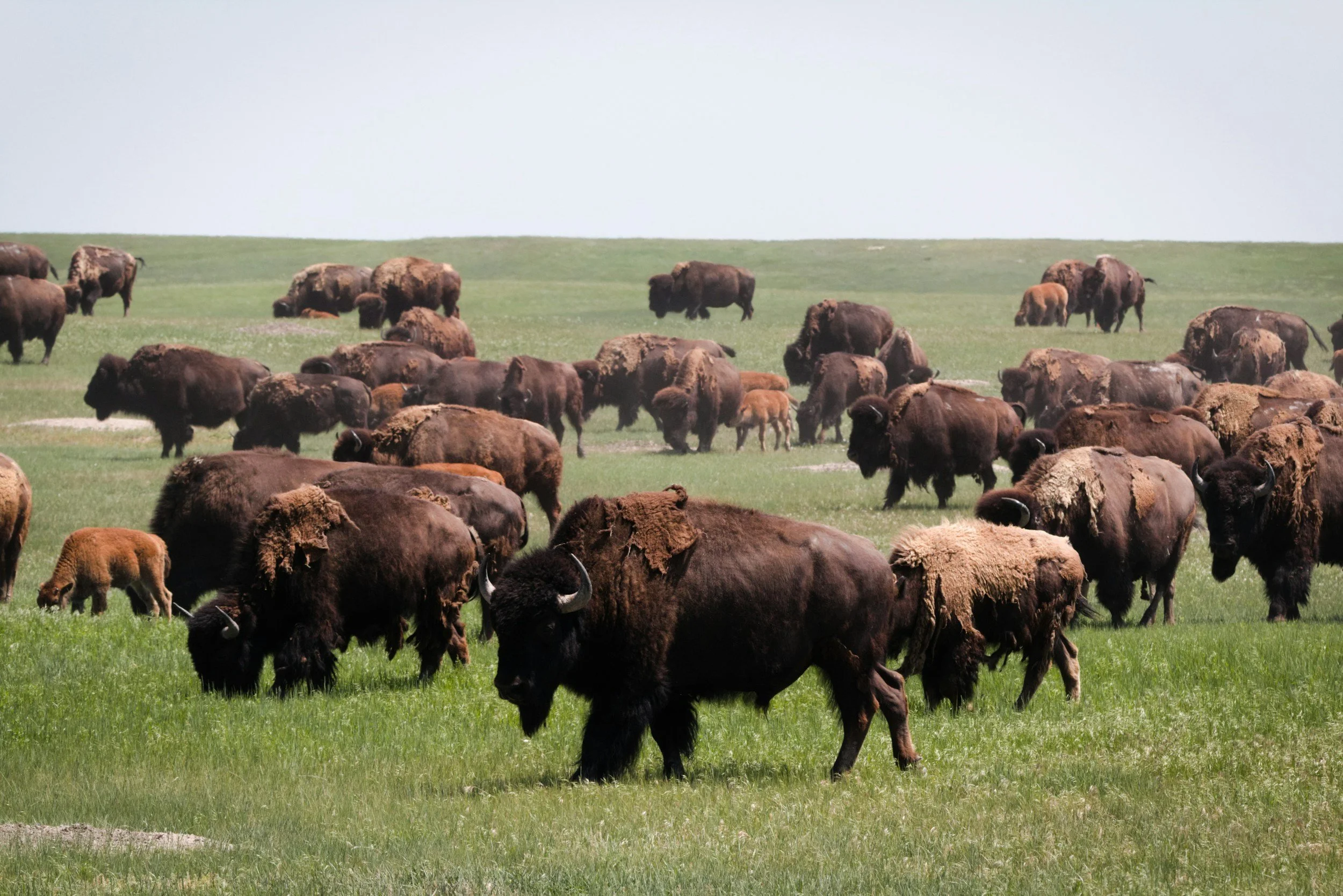
Before 1800, upwards of 60 million bison roamed the continent in sacred relationship with humans, playing a vital role in thriving prairie ecosystems and sinking carbon into the soil. When Indigenous people resisted imprisonment on reservations, U.S. cavalrymen tried to force their submission by intentionally destroying the buffalo herds on which they depended. By 1900, less than one thousand bison remained.
Today, industrial, colonial agriculture has plowed over and destroyed most Tallgrass Prairie, releasing carbon into the atmosphere and driving our climate crisis. This region is losing topsoil at a rate 100 times faster than it can be replenished. And due to chemical runoff from colonial agricultural practices on this land, there is a Dead Zone in the Gulf of Mexico larger than the state of Connecticut.
“It all got ‘broke’ at the same time—the prairie, the treaties, and the relationship between people and land. Between 1800 and 1930, 95% of the world’s Tallgrass prairie was converted to farmland. What took 12,000 years to become rich with thousands of species, took only 120 years to turn into an ecological desert, composed essentially of two species: corn and soybeans.”